

Australia’s World Cup Awakening: What I Saw in Melbourne on Sunday
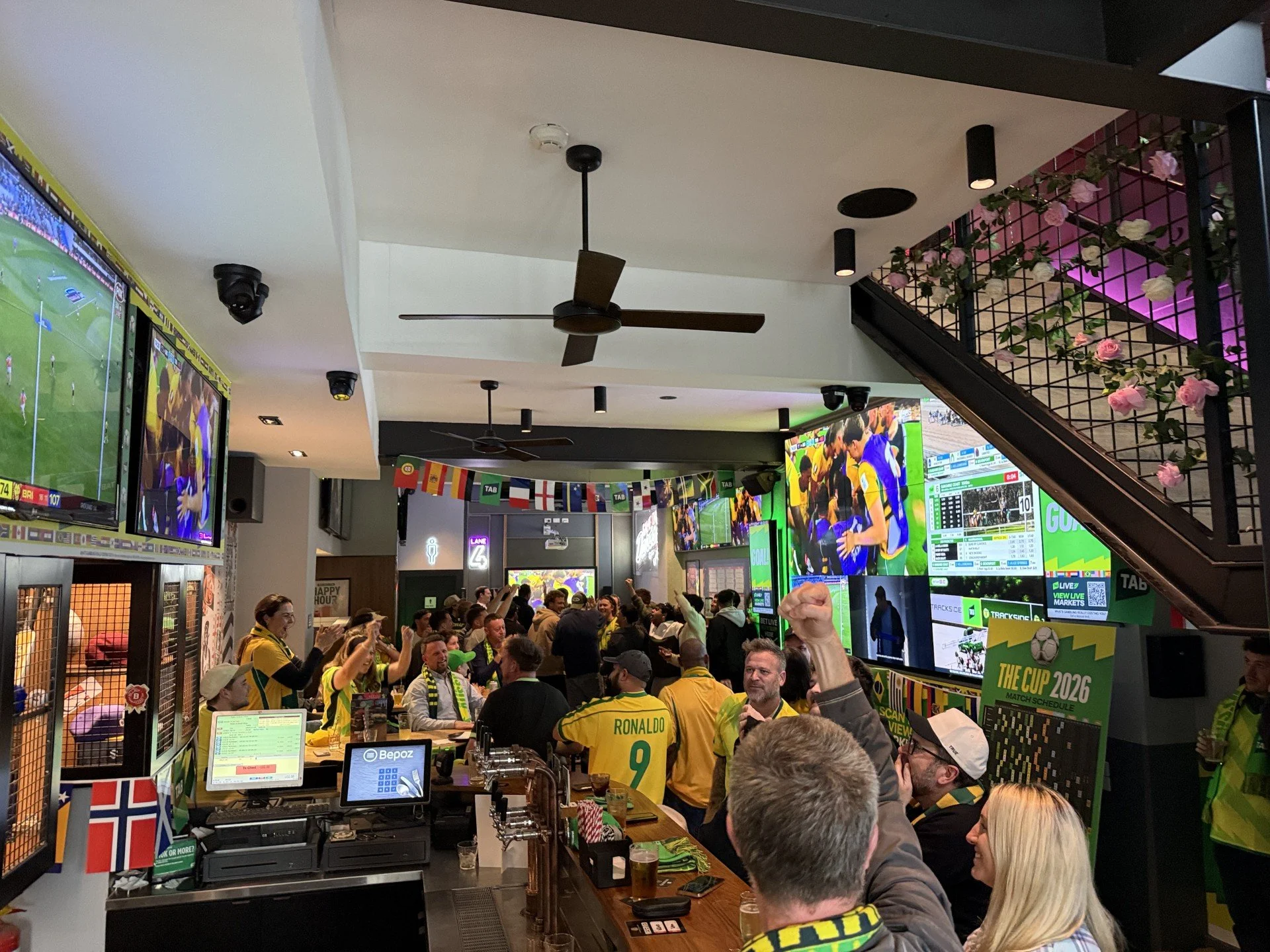
Melbourne’s pubs were a sea of green and gold on Sunday for Australia v Turkey in the World Cup
If you want to understand Australia’s relationship with the World Cup, forget the think‑pieces and the participation charts. Just spend a matchday in Melbourne. I did on Sunday, and what I saw was a reminder that this country’s connection to football is far deeper, louder and more emotional than the industry often gives it credit for.
I watched Australia beat Turkey from a pub that looked like it had been dipped in green and gold. Shirts, scarves, flags, face paint, the lot. The place was packed long before kick‑off, and by the time the teams walked out, you could feel the tension in the room like static. It wasn’t polite interest. It wasn’t casual curiosity. It was full‑throttle national investment.
TAB had a huge brand presence in the venue, and it actually made sense. It didn’t feel bolted on or opportunistic. It felt like they understood the moment and the mood.
Then 9 News turned up and filmed a piece from inside the pub. Nothing dramatic about that on its own, of course the networks are covering the World Cup, but what struck me was how naturally it fit into the atmosphere. They weren’t trying to manufacture a story. They were simply capturing something that was already happening. The energy, the noise, the crowd reaction, it all made sense for them to be there. And that was just one venue.
Across the city, the scenes were even bigger. Footage from Fed Square and AAMI Park went viral, thousands of people packed together, limbs everywhere, flares, flags, pure chaos. The kind of scenes you expect in football‑obsessed countries like Argentina, Turkey or Italy. Except this was Melbourne, on a Sunday, for a group match.
What made it even more special was the timing. This is my second World Cup living in Australia. The first was Qatar in 2022, and the match times were brutal, 2am, 3am, 4am kick‑offs that only the most committed could survive. This time, the timezone has been a gift. The win over Turkey landed in a perfect Sunday afternoon slot, and the country responded exactly the way you’d expect when you give Australians a major sporting moment at a civilised hour.
People love to say Australia isn’t a football nation. But when the World Cup rolls around, and when the games are on at the right time, the country behaves like one.
This is the nuance that gets missed. The domestic game doesn’t dominate the sporting landscape here, but the World Cup absolutely does. It becomes a national moment. A shared ritual. A reason for people who haven’t watched a minute of football in four years to suddenly know the starting XI and scream at a TV.
The Socceroos don’t need to be the biggest team in the country year‑round to command the nation’s attention during a World Cup. They just need to be there. And when they win, the country responds with a level of passion that would surprise anyone who only looks at A‑League attendances.
Sunday in Melbourne was a reminder that the World Cup is one of the few events that cuts across every demographic, every suburb, every background. It’s multicultural, emotional, and unifying in a way no other sport here quite manages.
For brands, broadcasters and rights holders, the lesson is simple: the World Cup isn’t a football moment — it’s an Australian moment. The opportunity isn’t in trying to convert people into long‑term football fans. It’s in understanding the cultural gravity of the tournament and aligning with it authentically.
I saw that firsthand on Sunday. A city acting like a football capital. A crowd behaving like they’d been waiting four years for this. A national team that, for a few hours, became the heartbeat of the country.
Australia’s relationship with the World Cup might be inconsistent, but when it peaks, it’s as powerful as anywhere in the world. If your organisation wants to understand how to tap into moments like this, and turn cultural energy into commercial impact, that’s exactly what I do at F42.